What does it actually look like to study engineering while building a specialty coffee roastery?
It's been almost two years since we started Ramkat. If you've watched our origin story on YouTube, you already know it began as a passion project, something we honestly thought was impossible at the time. It was something we did to skip class, or to forget for a while how much we were struggling with our degree.
To understand why coffee mattered so much, you first need to understand what we were running from.
Second Year: Where Engineering Tries to Break You
Second-year Mechanical Engineering is widely known as the most time-consuming year of the degree, and maths sits right at its core. There are two maths modules in the first semester and another two in the second. Those second-semester modules are the ones so many students fail, and failing them often means an extra year of study. For some, it's the point where they seriously consider dropping out.
And that's just the maths.
Alongside it you have MOW (design and manufacturing), the core of what makes you a mechanical engineer. Then thermodynamics, dynamics, programming and statistics. Put all of that together and you get a very specific kind of student: tired of differential equations, linear algebra and calculus, spending hours in tutorials and practicals, and quietly wondering whether they signed up to study engineering or mathematics.
We hit that wall hard. And we drank a lot of coffee getting through it.
How Coffee Became Our Escape
Somewhere in all that caffeine, the passion started. We needed a way out of the equations and the noise, even for an hour, and coffee became that place. We started learning about origins, brewing and roasting, and before long the thing we used to escape our degree had become something we wanted to build.
If there's one thing we'd tell any engineering student, it's this: find something that keeps you sane. A degree like this will eat you alive if you don't have somewhere else to put your energy. For us, that was coffee.
Third and Fourth Year: Less Maths, More Everything
You'd think it gets easier once the maths stops. It doesn't. Third and fourth year have no maths modules, but the workload roughly doubles, with more projects, more reports and more deliverables than ever before.
And while the degree got heavier, so did life. Today, alongside our studies, we're:
- tutoring high school maths and science
- training functional strength and mobility in the gym or rock climbing
- more involved in church than ever
- planning a wedding, since I recently got engaged
- trying to grow a house-sitting and pet-sitting business
- and raising baby Ramkat, which needs constant attention and nurturing to grow into what we've dreamed it could be
So with all of that on the table, the question we get most is a fair one.
So How Do We Actually Do It All?
Honestly, it's a question we still try to answer every single day.
In the beginning, we handled everything as it came. Whatever was loudest got our attention. That worked for a while, until it didn't. Now we run everything through a Google Calendar with set times for each part of our lives: academics, coffee, church, family, relationships, recreation and gym.
Here's roughly what a typical week looks like:
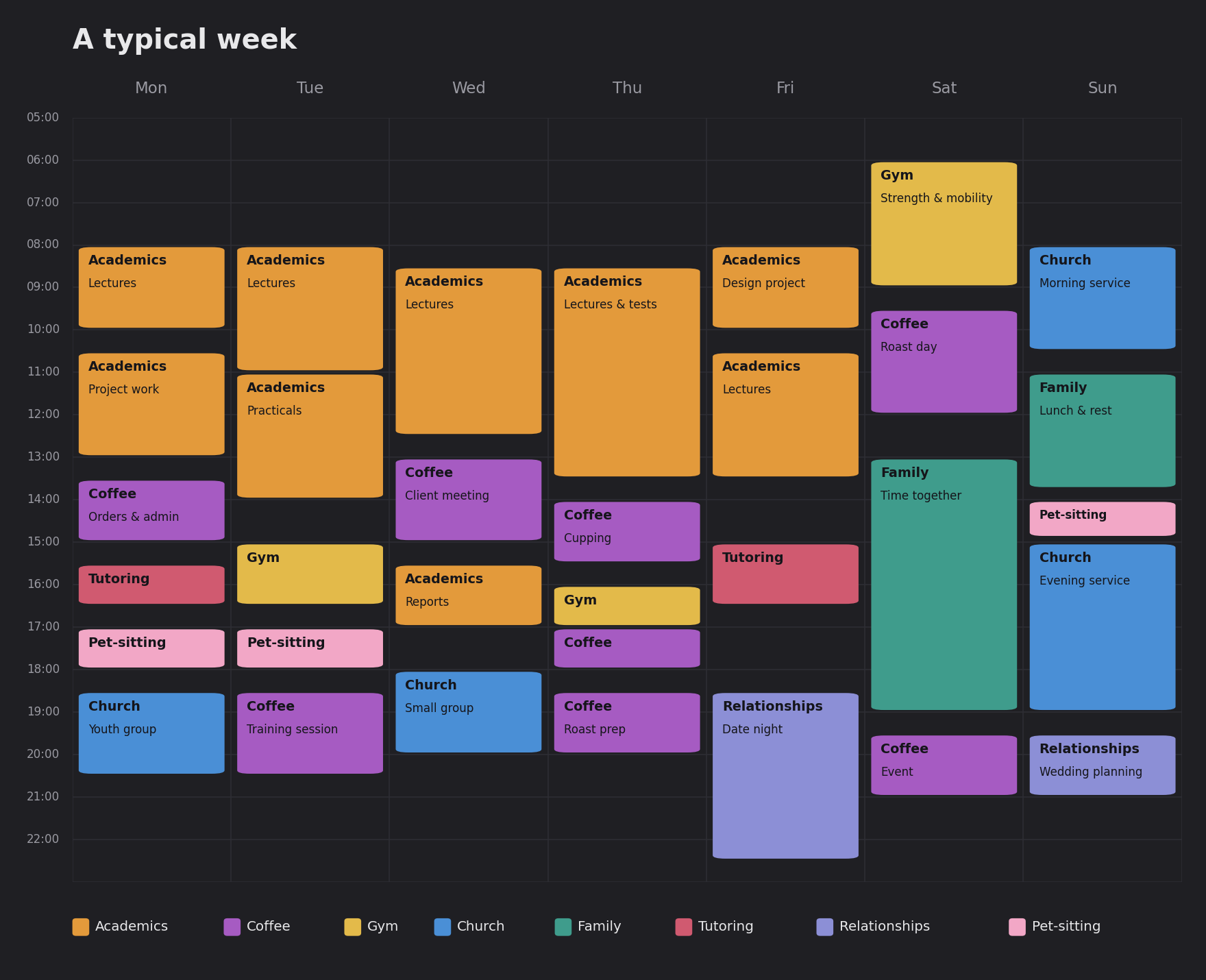
That might look rigid, but without it your mind is everywhere except where you are. You're thinking about coffee in class. You're doing Ramkat admin when you're supposed to be resting. You're answering emails between sets at the gym, or putting on your coffee-thinking hat in the middle of wedding planning. The calendar isn't about control. It's about being present in whatever you're doing right now.
Everyone Says "Prioritise." Nobody Tells You How.
This was the part we had to figure out for ourselves.
We took every area of our lives and asked the same question: where do we want to be in five years, and what do we want to have achieved by then? That gave each area its own vision. From there, we attached KPIs (measurable targets) so we could actually track whether we were moving toward that vision or just staying busy.
Academics is a good example. After a few years of studying, we know roughly how much time a semester really needs. Every semester is different, but the core stays the same: classes, projects, reports, tutorials, class tests, tutorial tests and practicals. You know your timetable in advance and you know what each module requires of you. The goal is to pass, so you break your week into focused work sessions for each module.
Here's the uncomfortable truth, though: with everything we do, it's impossible to keep up with everything the university asks of you. It's arguably impossible even if university is your only focus. So "keeping up" stopped being the goal.
The goal became efficiency. Knowing which tasks deserve hours of deep work, and which ones can be handled in a quick session with an AI tool. Knowing where the real value is and putting our time there.
That way of thinking has changed us more than we expected. When we applied it during vacation work at engineering companies, working on real-world projects, it made us better engineers. Now we apply the same approach to everything else we do, including Ramkat.
Why We Don't Believe in Balance
Balance is a word we've stopped using.
Think about balance like a pizza. You cut it into even slices and hand one to relationships, one to business, one to studies, one to fitness. Every part of your life only ever gets a fraction of you. To us, that's inefficient.
We prefer words like interconnection. Intertwined. Symbiosis.
Instead of dividing ourselves up, we try to give 100% of who we are to everything we do. And we've learned from experience that it all feeds into itself. Coffee has taught us lessons that made us better engineers. Engineering has taught us how to be better businessmen. Every high and low, in any part of our lives, has shaped the whole of who we are.
Don't get us wrong: separating your attention still matters. You can't dial in an espresso recipe during an exam, and you shouldn't be answering supplier emails at the dinner table. But that's focus, not balance. If you spend your life chasing balance, you'll be chasing it forever. Unless you're planning to become a monk.
Over to You
There's far too much to unpack in one blog, but we hope this gave you a glimpse of what life behind Ramkat really looks like. There might just be a Part 2.
Before that, we'd love to hear from you. How do you prioritise when everything feels important? Do you have a system, a calendar, a set of non-negotiables? Or are you still searching for balance?
Send us a message on Instagram and tell us how you make it work, and what your version of "coffee" is. The best answers might just make it into Part 2.